Get early access to listings that match your criteria
Never miss an opportunity again. Our personalized alerts notify you instantly.

 English$ USD · m²


A 10-dwelling hamlet on 31-hectare grounds, perched on a rocky promontory, twenty minutes from Angoulême in the department of Charente . Set within a rolling landscape, the property, perched on a rocky outcrop, overlooks the valley and the nearby river that borders the estate to the southeast. Accessible from the north via a drive that passes, on the right, garages carved out of the rock as well as the large openings of the former 5,000-m² quarries, which, more recently, have been used to grow mushrooms, it then ascends to the centre of the six-dwelling complex. The main dwelling is positioned in the middle, with a raised bakehouse to the east, while four dwellings skirt the promontory to the south and a last one is located to the north, as is a converted greenhouse to the northwest. At the foot of the rocky outcrop, two large openings lead to underground galleries of 600 m² and six springs, surrounded by large ashlar stones, are scattered throughout the meadow to the south that reaches all the way to the base of a cliff. In addition, vast meadows surrounded by woodland extend to the north of the building complex.
…By Patrice Besse


A house dating back to the 19th and 20th centuries with outbuildings and a 5,500m² garden, five minutes from the city of Cognac in France’s Charente department. The edifice’s main section was built in the 19th century. It faces north and south. An annexe that stretches north was added to its west end. And from its south-east corner, another annexe, which is more recent, adjoins the building to form an L shape with it around a courtyard. A country road runs alongside the outer wall and railings on the east side, where there is a pedestrian entrance. There is also a northern entrance on the court side and a southern entrance on the garden side beside a tall conifer and a square dovecote. There are different outbuildings too, both on the north and south sides.
…By Patrice Besse


A 19th-century manor house with outbuildings and six hectares of grounds in a protected natural zone where France’s Charente, Charente-Maritime and Deux-Sèvres departments meet. The grounds are located just south of a hamlet. The dwellings in this hamlet border the property’s northern meadows. The manor house faces south-west and looks out at a tree-dotted space. On each side of the manor house, two long buildings form a U shape with the main house. Two towers with pointed cone roofs adorn the complex on both sides. One of these towers adjoins the northern outbuilding. The property’s entrance gate faces a 150-metre-long drive lined with trees. This drive runs up to a road. On the south-east side, there are other outbuildings: a dwelling with an enclosed garden, farm buildings and looseboxes.
…By Patrice Besse


A large, elegant and comfortable house and its neighbouring building in need of restoration, in a beautiful dry-stone village in the upper Sèvre valley. The main house, built out of rubble limestone, overlooks, on its garden side, the Sèvre River from all four of its storeys, while its other façades look out on one of the most beautiful villages in the department with its medieval chateau. All the living spaces are located on the ground floor, which includes: a large living room, a small sitting room, a library or office and dining room, all decorated with nailed wide-plank hardwood floors, a variety of different fireplaces and ceilings with exposed beams or delicate stucco patterns, while the kitchen, left in its original state, has an antique square terracotta-tile floor. In the other building, a vast room, called “the chapel”, accessible via the small sitting room, could be used for galas, concerts or theatre performances. The first floor contains four bedrooms, each in a unique style – one of which has a powder room with lavatory – as well as a vast separate shower room with lavatory. On the second floor, under the insulated roof, a lounge space opens onto the staircase, while a last bedroom, bathed in sunlight, is located near the bathroom with lavatory. The rest of the floor is reserved for the attic space. As for the garden level, it includes a summer kitchen and furnace room (wood-pellet central heating), a workshop, a summer shower room with lavatory and a cellar. The house’s tile roof is in great condition as is the roofing for the outbuildings, while most of the windows are double-glazed. The garden is organised into six spaces, including the courtyard enclosed on three of its four sides by two barns and the deep, asymmetrical quadrilateral swimming pool. The four storeys of the house in need of restoration – which a small courtyard separates from the first – are accessed by a spiral staircase, which is undoubtedly older than the date displayed above the building’s arched front door: 1724. Although some of its window frames have been changed recently and the shutters are new, there are eight rooms in total that need to be refurbished, in addition to three cellars and two attic spaces. An interior garden, in which a palm tree provides a Mediterranean touch, opens onto a patio under which, thanks to the slope of the street that descends towards the bridge over the river, a garage was created.
…By Patrice Besse


An 1860 house, outbuildings and three independent dwellings in a 5 500 m² green setting between Bordeaux and La Rochelle. . The property is entered to the north-west of the village, via a gate that reveals the house’s beautiful facade on the right, after the adjoining outbuilding which has been into converted accommodation. It faces the parkland to the east, while to the west, the patios of the other houses are set in a wilder, more intimate area. To the right of the entrance gates, on the street side, there are the garage and a barn. A pigsty and an old chicken coop line the lane to the east.
…By Patrice Besse


A manor house, two gites and outbuildings in 8 hectares of wooded grounds in a village, 30 minutes from Poitiers . A small country road runs alongside the property wall to a gate enhanced by two pillars supporting an imposing, sober iron gate. Once past the entrance, two houses appear on either side, each with its own private outdoor space, and further on, there are outbuildings. The manor house is revealed next, followed by the grounds. The main building dates back to the last years of the 18th century, the Directoire period. A wing and stairway tower were added at the beginning of the 20th century copying the original style. A bossed arch on the facade highlights the entrance, which is topped by a balcony. Pedimented dormer windows have been added to the concave Mansard roof on the manor house. The wing has a four-sided slate roof. Render has been applied to all of the facades and the corner ties and window frames are ashlar. Under the 20th century wing, there is a cellar which is accessible from the outside. The two guest houses, situated at the entrance to the estate, one with a small private courtyard and the other with a garden area, are the same style, with stone dressings and canal tile roofs.
…By Patrice Besse


In a spa town between Bordeaux and La Rochelle, a discreet, 230-m² house, its tree-filled garden, large upper patio, garage and studio. Rectangular in shape and built over two levels, the house is topped by barrel tile roofs, the organisation of which demonstrates that initially, there were most likely several houses and outhouses built one after the other depending on the needs at the time. The visible stone masonry is punctuated by numerous windows and doors surrounded by ashlar stone. On the garden side, the ground floor rooms are connected via a 20-metre gallery along the façade, looking out over the garden with its picture windows. As for the upstairs, this floor includes a patio of approximately 65 m², which extends along the entire length of the house. From there, the view extends to the rooftops of the city’s chateau and, on the right side, over the Romanesque church’s bell tower. Right next door, a covered and converted section provides access to a small courtyard adjacent to the studio, which looks out over one of the town’s squares.
…By Patrice Besse


A hamlet of three houses including a water mill with its wheel, a swimming pool, river, islands and meadows, all set in almost 5 hectares of land 30 minutes from Angoulême . Accessible from the main road, a path crosses the meadows dotted with a few horse stalls and leads to the hamlet, which is bordered to the north by the millstream. The house, to the north, overlooks a first island linked by a footbridge to a second bordering the millstream, followed by the weir separating it from the third island with its meadow, linked by a footbridge over 30 metres long. The three dwellings form an open U-shape to the east, organised around a courtyard with a fountain in the centre. Below on the right, behind an olive tree topiary, there is a rectangular swimming pool measuring 5 m x 15 m, with railing around it and a summer kitchen with a roof over it. The meadows bordered by the river to the north, the mill run and the three islands are mainly lined with large trees such as poplars, willows and alders.
…By Patrice Besse


An early 17th-century house to restore, on the edges of the Charente and Dordogne, with outbuildings set around a square courtyard, a dovecote and more than 3 hectares of land. The many buildings that comprise the property, with their gabled roofs made of terracotta half-round tiles, are set around a square courtyard and are all in need of renovation. The courtyard can be reached via a carriage gate and an adjoining pedestrian gate in the south facing surrounding wall made of ashlar, quarried from various locations in the region. The keystone of the carriage gate is adorned with two hearts facing each other, one the right way up and the other upside down. An ashlar stone building with a gabled roof stands to the left of the entrance, adjoining the buildings. A dovecote with a pavilion hip roof stands at the southwest corner. The garden, orchard and a lawned area that form the grounds of the property lie to the west.
…By Patrice Besse


An Empire-style country residence and its outbuildings set in 1.3 hectares in a 'Petite Champagne' village 20 minutes from Cognac . From the street, a gate opens onto the property. A driveway provides access to the central entrance door of the residence. Topped by a tiled hip roof, this classical-style building impresses with its highly symmetrical facades. Rectangular in plan, it has three stories outlined by stringcourses. The dressed stone front and rear facades feature seven bays with large-paned windows protected by shutters. Tiny windows typical of the Charente area define the top floor. Outbuildings surround the residence on three sides and define the courtyard. At the back of the courtyard, opposite the main building, a dovecote with a tiled pavilion roof rises above the adjoining outbuildings. The courtyard features cypress trees and a large chestnut tree. To the south-east, below the garden separating the main residence from the country road, there is a parking area, complemented by another parking area of almost 1,000 m² on the other side of the road.
…By Patrice Besse


In the scenic Vienne region, in the centre of grounds crossed by a river, a traditional farmhouse with full French ownership rights and two guest houses . The property can be accessed via two entrances, the first providing direct access to the grounds and the second to the farmhouse via a courtyard, where a covered area has been created with space for two cars. A caretaker's cottage is located a few meters from the main entrance. The stone farmhouse has a flat-tiled roof. Its two facades are dotted with windows, some with French windows, which are echoes of each another. In the grounds, a first guest house can be accessed via the garden gate and by going past the front of the farmhouse, which is just a few metres away. Built of exposed stone with a tiled roof like the farmhouse, it faces the mill and a reservoir formed by the water from the millstream. The mill, set opposite these first two dwellings is the focal point of the whole complex. The mill's history can be traced back to the 17th century, when its dykes were built. Destroyed by a fire in 1790, it was rebuilt in 1800 and still has water rights to this day. Its drop height is around 1.8 m. It should be noted that all the dykes have been bricked up and raised to protect the buildings from possible winter flooding. Finally, a second guest house has been built on the first island and is linked to the shore by a small bridge and accessed by a stone staircase. Another bridge leads to a second, even larger island.
…By Patrice Besse


A renovated listed church and its 5,000 m² of grounds in a village 15 minutes from Poitiers. The church, designated 'basilica', stands out for its prominent position in the village. An avenue of plane trees marks the entrance to the grounds surrounding the edifice. Built of rendered limestone between 1884 and 1889, the church reflects the Medieval Revival architecture and other eclectic elements of a period marked by the influence of Viollet-le-Duc. It has a groundplan in the form of a Latin cross with a single nave. Its bell tower-porch, designed by the architect Alcide Boutaud, has an unfinished facade, known as a “bonding facade”, which lends it an almost Romanesque style, even though the structure adopts Gothic architectural references. Two metal spiral staircases flank the entrance and lead up to a balcony, where a large pointed-arch opening with double-glazing provides access to a fully restored organ. On either side of the nave, large galleries form a cloister which links the doorways to the chapels. Their entrances are embellished by two pointed arches and two attached pilasters. These galleries have been double-glazed and fitted with new-generation radiators. The entire basilica, including the sacristy, was included in the French National Heritage List by decree on 4 January 2011.
…By Patrice Besse


An old, well-developed house that towers over a beautiful village in the Gâtine poitevine. The main dwelling faces southwards, standing between a round tower and a square one that was reduced in height. A terrace extends in front of it, providing space for meals, conversations, naps and reading on sunny days. The reception rooms lie either side of the house’s seventeenth-century entrance door, which takes you into a spacious hall. To the right is a parquet dining room with a fireplace and to the left is an equally sumptuous living room. A boudoir, or office, separates the living room from a large bedroom that includes a washstand and an Empire-style bath. This bedroom leads out into the garden. The room connects to a bathroom in a seaside-resort style that takes up the round tower’s ground floor. A kitchen and scullery lie parallel to the dining room towards the middle of the edifice. The kitchen opens eastward to the outside. The scullery leads to a patio with access to a woodshed, boiler room and former laundry. Two staircases take you to the first floor, which is made up of three bedrooms, a linen room, a bathroom, an office and two lavatories. In the middle of this storey lies an extensive playroom under exposed beams. The room has many purposes. For example, it can serve as a children’s dormitory, a television room or an area for fun afternoon snacks. Almost all the windows are double-glazed. Most of the ceilings are insulated and large cast-iron radiators emit the heat produced by the oil boiler very effectively. Most of the roofs are new or recent. The cellar is spectacular under its ribbed vault (transverse arch in the middle). The annexes adjoining the house include a former stable, a garage and a storeroom under an extensive attic. The sanitation system needs to be only partially changed. The lush garden, which leads right up to the house, offers a delightful bucolic view over a 2,800m² area of flower beds, trees and grass. On the other side of the small access road lies a half-hectare meadow with a row of walnut trees running across it.
…By Patrice Besse


An old watermill to be restored with a two-hectare lake, a fishery and three hectares of woods in France’s Charente department, thirty minutes from the town of Angoulême. From the secondary road through the hamlet, a tarmac lane leads east and quickly takes you to the watermill, edged with water on its north side. Beyond it, a stream flows from north to south across the property, between the house and a lake surrounded by dense woods. A small island in the middle of the lake becomes a peninsula when the water is at its lowest level in the summer. The enclosed lake can be supplied with water from the north. On the south side, a sluice gate leads to a fishery where fish can be caught by draining the lake.
…By Patrice Besse


A house and its barn waiting to be renovated, nestled on Oléron Island on around four hectares of a protected natural area. The property includes a house with a barn that stands to the south-east. A few other dwellings edge its south side. The main entrance is also on that side. To the east, an inconspicuous lane runs through greenery up to the house. The property covers nearly four hectares, stretching northwards and eastwards to former salt pans. Lush vegetation dominates the site. Small trees and clusters of shrubs cover almost all the land, except for a pond that lies towards the north-east corner.
…By Patrice Besse


In the Vienne, 20 minutes from Châtellerault and 30 minutes from Poitiers, an old chapel has been enlarged and converted into a family home. In a hamlet, at the end of a dead-end street and attached to the wall of the property, a gate opens onto part of the garden and a pool. A little further on, the L-shaped house consists on one side of the former 15th-century chapel, with its rendered stonework, and on the other of a modern section. The roofs are new, made of mechanical canal tiles.This description has been automatically translated from French.
…By Patrice Besse


In Portes-en-Ré, a contemporary villa inspired by the island's architecture, over 300 m², with its swimming pool and gym. Behind a long white wall, the property gradually reveals itself in the spirit of the large Rêtaise houses. A gate opens onto a gravel courtyard, while a pedestrian door in the wall leads to a covered porch that marks the entrance. A welcoming garden consists of bamboo, palm trees, grasses, and Mediterranean plants. Beyond that, the villa appears in fragments and is organized into several volumes arranged around various successive patios. The old Rêtaise houses often resulted from the gradual aggregation of buildings related to the activities of salt-makers or winemakers. Living spaces, salt warehouses, or old cellars were connected by courtyards protected from the wind. The property adopts this logic in a contemporary interpretation. The lime-rendered facades, dark shutters, and canal tile roofs reflect the architectural codes of the island, while large glass openings establish a fluid relationship with the outdoors. The entire project, in its volumes as well as its interior arrangements, was designed by architect Jeanne Dumont. The materials assert the character of the building: brick floors laid in a dark pattern on the ground floor, oak flooring with small strips on the upper level, fine carpentry, wooden paneled ceilings, and often custom-made furniture.This description has been automatically translated from French.
…By Patrice Besse


In Vienne, on over 2.8 hectares, an old farmhouse has become an artist's house. The property appears at the end of a paved path. Once the gate is crossed, numerous outbuildings precede the house, which features six bedrooms and two bathrooms. The facades are made of plastered stone and the roofs are tiled with canal tiles. The doors are double-glazed. The large outbuilding has been converted into a workshop and exhibition room and contains many spaces and volumes. The building, which includes a garage, a bread oven, and old pigsties, is used for storage but could be subject to rehabilitation. Finally, the porch allows for the storage of equipment for maintaining the outdoor areas.This description has been automatically translated from French.
…By Patrice Besse


A fully renovated, 18th-century manor house, 10 minutes from Poitiers, in 2-hectare grounds with a swimming pool. A small country road runs alongside the property and leads to its two entrances. The first is made up of an entrance porch with a wooden gate, while the second possesses a wrought-iron railing gate. After the first entrance, there are garages followed by a wing in front of which a patio has been installed. The main residence can be found at the end of this L-shaped building, enhanced by an ornamental garden. The façades of the main residence are rendered, with stone quoins as well as window and door frames, while the wing boasts exposed stonework. All the roofs are made up of half-round tiles, plus the entirety of the windows are double glazed. Between the house and the garages, a pond, into which a stream flows, was created in the 18th century. The garden extends to the rear and below the house, with a swimming pool at the same height as the main residence and second entrance.
…By Patrice Besse


In Charente, at the gates of Angoulême, a Charente residence from the 19th century, its outbuildings, and its swimming pool on 3 hectares of wooded land. The building complex is organized according to the traditional layout of old Charente farms: a main living building, extended and framed by outbuildings forming a semi-closed courtyard in a U-shape. The main house, built of rendered stone, features a sober architecture topped with a hip roof, inspired by rural styles. The arrangement of the façade, punctuated by regular openings, reflects a pursuit of balance rather than grandeur. The discreet but structuring window frames emphasize the rigor of the composition. The roof of the outbuildings, with its two slopes, follows the local tradition, with a moderate pitch suited to the region's climate. The clear and readable volumes testify to a construction designed to last, where each element serves a specific function. On either side, the outbuildings—barns, stables, and annexes—exhibit a more rugged form. Their generous proportions, large openings, and frameworks reflect their original agricultural purpose. The U-shape layout is not merely functional: it creates a protected inner courtyard that is almost intimate, sheltered from prying eyes. Thus, the whole forms a small coherent and hierarchical territory in itself, where living and working once coexisted in harmony.This description has been automatically translated from French.
…By Patrice Besse


At La Flotte, an old farming hamlet from the 18th century with several houses around a garden surrounded by walls. The property develops in depth, according to an organization inherited from an old agricultural ensemble. The various buildings, all on one level, surround a central garden. Part of the plot creates protected spaces, while some openings reveal perspectives between the volumes. The layout allows for both the guarantee of privacy and a certain breathing space. The whole includes a house as well as several old constructions: a wine cellar, a grain storehouse, a barn, and a sheepfold which have undergone successive modifications. The organization distinguishes three sets of autonomous housing. The facades, made of exposed stone or plastered, are covered with canal tiles. The exterior woodwork, mostly painted blue, punctuates the elevations. The floors are mostly composed of old tiles, present in most rooms, accented by a few spaces with terracotta tiles.This description has been automatically translated from French.
…By Patrice Besse


A restored farmhouse with an outbuilding, a swimming pool and over 6,000m² of grounds, nestled in France’s beautiful Vienne department. The property comes into view at the end of a tarmacked lane. A gate leads into the grounds, where an outbuilding stands in front of the main dwelling and a guesthouse, which have both been renovated with the same level of comfort for both of them:, including bedrooms with their own bathrooms and generous spaces. A swimming pool forms a link between the two dwellings. Exposed stonework forms the elevations and flat tiles cover the roofs. All the windows are double-glazed.
…By Patrice Besse


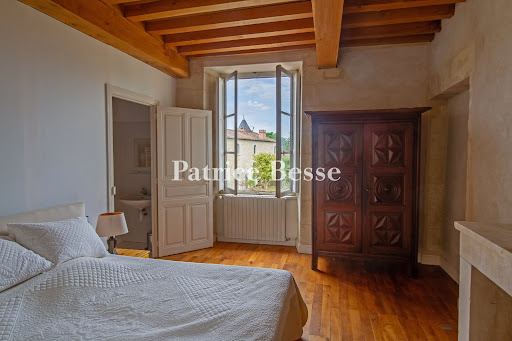
A fully renovated 13th-century residence and a 19th-century manor house to be restored, in the north of the Vienne area, in grounds of more than 4 hectares. A gate opens into the property and once through it, three buildings loom into view: the village’s church, of which a side borders the plot, the 19th-century manor house opposite the entrance and, lastly, the medieval residence, entirely renovated by the Ateliers Perrault firm. Its elevations are typical of its era, boasting exposed stonework and semi-circular arched doorways. The roof has been renovated plus the entirety of the windows are double glazed. To the rear, the 4 hectares of grounds spread out around the outbuildings, including a tennis court and a wooded area made up of hundred-year-old trees.
…By Patrice Besse


In the town center of Montmorillon, a bourgeois residence from the 18th century, with its garden and orangery. In a quiet street, the house is surrounded by many bourgeois residences, extended by their lush gardens. The property extends behind a monumental stone gate, formed by an elegant round arch made of radiating voussoirs and closed by a massive wooden carriage door with two leaves. The porch used to provide access to pastures, where racehorses were housed. Long occupied by a notable family from the region, the main dwelling dates back to the 18th century. The building is two stories high, flanked by two side wings in a U-shape. The whole is rhythmically punctuated by numerous openings facing the courtyard as well as the tree-lined garden. The roof is covered with flat tiles, and the frames of the openings and the corner chains are made of stone.This description has been automatically translated from French.
…By Patrice Besse


15 minutes from Poitiers, a 19th-century castle, partly listed as Historic Monument, founded in the Middle Ages, with its outbuildings in a hamlet and its park of 22 hectares. Accessible through several gates, the property is hidden behind high walls and the foliage of ancient trees. From the main entrance, the castle gradually reveals itself through a line of plane trees. The building is a testament to several construction phases. From the medieval era, an old keep, altered in the 14th century and listed as a Historic Monument, still stands. With a balanced plan, its facade is rhythmically punctuated by large bays and dormer windows. The roof is slate, and the walls are rendered with exposed stone corner chains. The main expansions date from the Renaissance, but it is in the 19th century that the most significant transformations took place. Turrets, dormer windows, large bays, and pinnacles reflect these various periods. Thus, in 1356, during the Hundred Years' War, Jean II le Bon is said to have stopped there during the Battle of Maupertuis. Later, Louis XIV is said to have stayed there on his way to Saint-Jean-de-Luz for his marriage to Maria Theresa of Austria. On the guardrails of the high windows, a Latin motto reads: "Peace to this house." To the west, a terrace bordered by columns is extended by a pergola and a fountain placed on the lawn. The outbuildings, distanced from the castle, form a complex with various uses. The whole is surrounded by the park, woods, meadows, and orchard.This description has been automatically translated from French.
…By Patrice Besse
'%20stroke='%23DDAA3A'%20stroke-width='1.909'%20stroke-linecap='square'%20stroke-linejoin='bevel'/%3e%3c/svg%3e)
Receive by email any new listing that may match your search criteria
Your criteria :
By validating this form, you accept the general conditions of use of Le Figaro Properties.
These agencies offer a selection of luxury properties vente in Poitou-Charentes. Feel free to contact them for personalized assistance.


